
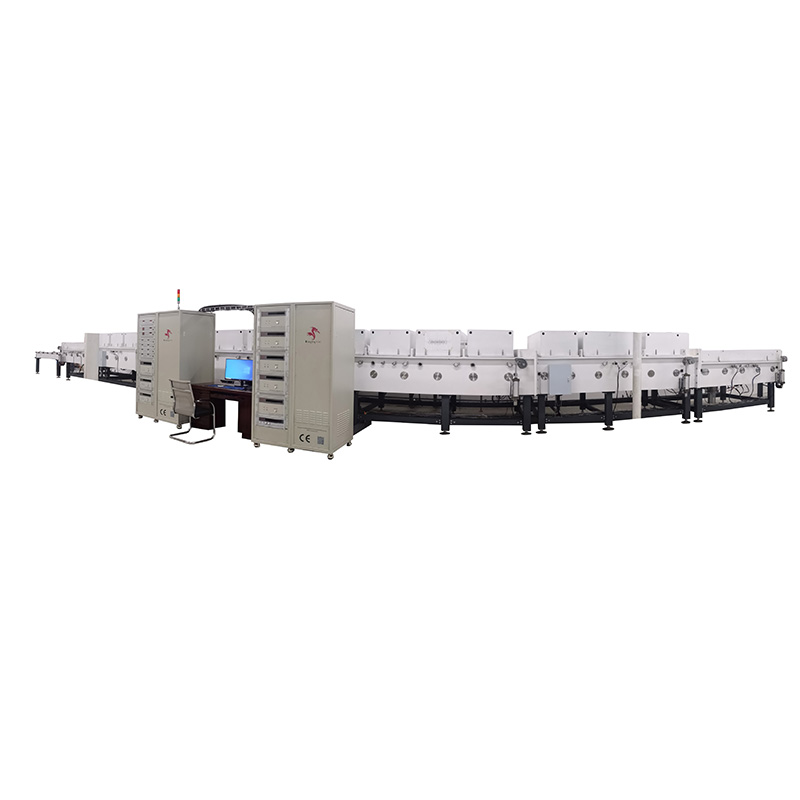
This line is a high-performance, multi-layer anti-reflective (AR) coating solution specifically engineered for Magnetron Sputtering Systems. Designed to maximize optical transmission while ensuring superior durability, this turn-key solution is ideal for architectural glass, display covers, solar panels, and high-end optical applications.
By utilizing reactive sputtering processes, it deposits precise metal oxide layers that create a destructive interference effect, virtually eliminating surface reflections across the visible spectrum.
Key Features & Benefits
-
Ultra-High Transparency: Achieves a peak light transmission of >96% and an average reflection of <1% across the 420nm to 680nm visible range.
-
Multi-Layer Engineering: Utilizes alternating high and low refractive index materials (e.g., Nb₂O₅/TiO₂ and SiO₂) to create a broadband anti-reflective effect.
-
Excellent Uniformity: Formulated for the high precision of magnetron sputtering, ensuring layer thickness uniformity of ±1.5% across large substrate areas.
-
Superior Durability: The fully inorganic coating is hard, dense, and resistant to abrasion, humidity, and thermal cycling. It passes MIL-C-48497A and ISO 9211 standards for environmental durability.
-
Ease of Integration: Compatible with both DC and Mid-Frequency (MF) reactive sputtering processes, offering stable deposition rates and minimal arcing.
Typical Coating Structure
The standard solution employs a 4-layer or 6-layer design to flatten the reflection curve:
-
Substrate (Soda Lime, Borosilicate, or Display Glass)
-
Layer 1: Medium Index Layer (Adhesion Promoter)
-
Layer 2: High Index Layer (e.g., Nb₂O₅, TiO₂, Si₃N₄)
-
Layer 3: Low Index Layer (e.g., SiO₂)
-
Layer 4: High Index Layer
-
Layer 5: Low Index Layer (Final Protective Capping Layer)
Note: Custom layer stacks are available for specific substrate refractive indices or color requirements.
Target Materials (Consumables)
Our solution is optimized for use with high-purity planar or rotary targets:
-
Silicon (Si): 99.99% for SiO₂ reactive deposition.
-
Niobium (Nb) or Ti (Ti): 99.9% for high-index layers.
-
Ceramic ITO: Optional for static dissipation if required.
Applications
-
Architectural Glass: Storefronts and windows to reduce glare and improve energy efficiency.
-
Display Technology: Touch panels, LCD/LED protection covers, and museum glass.
-
Solar Energy: Cover glass for photovoltaic panels to maximize light absorption.
-
Automotive: Dashboard displays and HUD (Head-Up Display) glass.